Building a Carriage House in Squamish: What Homeowners Should Know
Building a Carriage House in Squamish: What Homeowners Should Know
A carriage house can give you more flexibility on your property without moving away from the neighbourhood you already love.
For some homeowners, that means a private home for parents. For others, it means a place for an adult child to live more affordably, or a long-term rental that helps offset mortgage costs. Whatever the goal, a well-planned carriage house can add both function and value to your property.
At NewlinesADU, we help Squamish homeowners understand what is possible on their lot, choose the right build approach, and move through design, permitting, and construction with a clear plan.

Why more Squamish homeowners are building carriage houses
Most people are not building a carriage house just to add square footage. They are building one to solve a real problem.
A carriage house can work well for:
- multigenerational living
- long-term rental income
- housing for adult children
- a more flexible property setup for the years ahead
In a place like Squamish, where housing is expensive and land is limited, adding a small detached home can be a practical way to make better use of an existing lot.
What counts as a carriage house in Squamish?
The District of Squamish treats carriage houses, coach houses, and laneway houses under the broader category of Accessory Dwelling Units (ADUs). An ADU is a detached dwelling unit that is ancillary to the main home and can be located at grade or above an accessory building.
That matters, because the zoning rules are tied to the ADU definition, not just the label “carriage house.”
Key Squamish carriage house rules to know
The exact answer always depends on your lot, zone, servicing, easements, flood or debris-flow constraints, and the location of the existing house. Still, there are a few core District rules homeowners should know up front.
ADUs are widely allowed, but not every lot is straightforward
The District says ADUs are permitted in zones that allow a single-unit dwelling, and one ADU is permitted per lot. The District also notes ADUs are permitted on lots containing a single-unit dwelling.
The size limit is more specific than many people think
The current District page says an ADU cannot exceed 90 m² of gross floor area. Where the ADU is above a garage, the entire structure can be up to 180 m², but the habitable area of the ADU still cannot exceed 90 m². That is roughly 969 sq. ft. livable, or roughly 1,938 sq. ft. total structure for a carriage-house-over-garage setup.
Height and setbacks matter
The District says an ADU cannot exceed 8 metres or 3 storeys, whichever is less. It must also meet the minimum front and side setbacks for the zone’s principal building, and it must not be closer than 1.5 metres to the rear lot line, unless the rear lot line abuts a lane, in which case that setback may be reduced to 0.61 metres.
Parking is less of a barrier than many homeowners expect
The District’s current ADU page says an accessory dwelling unit does not require an additional off-street parking space.
ADUs are not permitted for short-term rental use
ADUs are not permitted for use as a short-term rental. If rental income is part of the plan, the safer framing is usually long-term rental housing.
Flood and hazard conditions can change the design
If a property is in an identified flood or debris-flow hazard area, the District may require a report from a qualified professional to confirm the site is suitable for development and to identify mitigation measures.
Choosing the right build approach
There is no single best way to build a carriage house. The right choice depends on your budget, your lot, your timeline, and how much customisation you want.
Pre-reviewed designs
A good fit if you want a faster path and are open to working within an existing design framework.
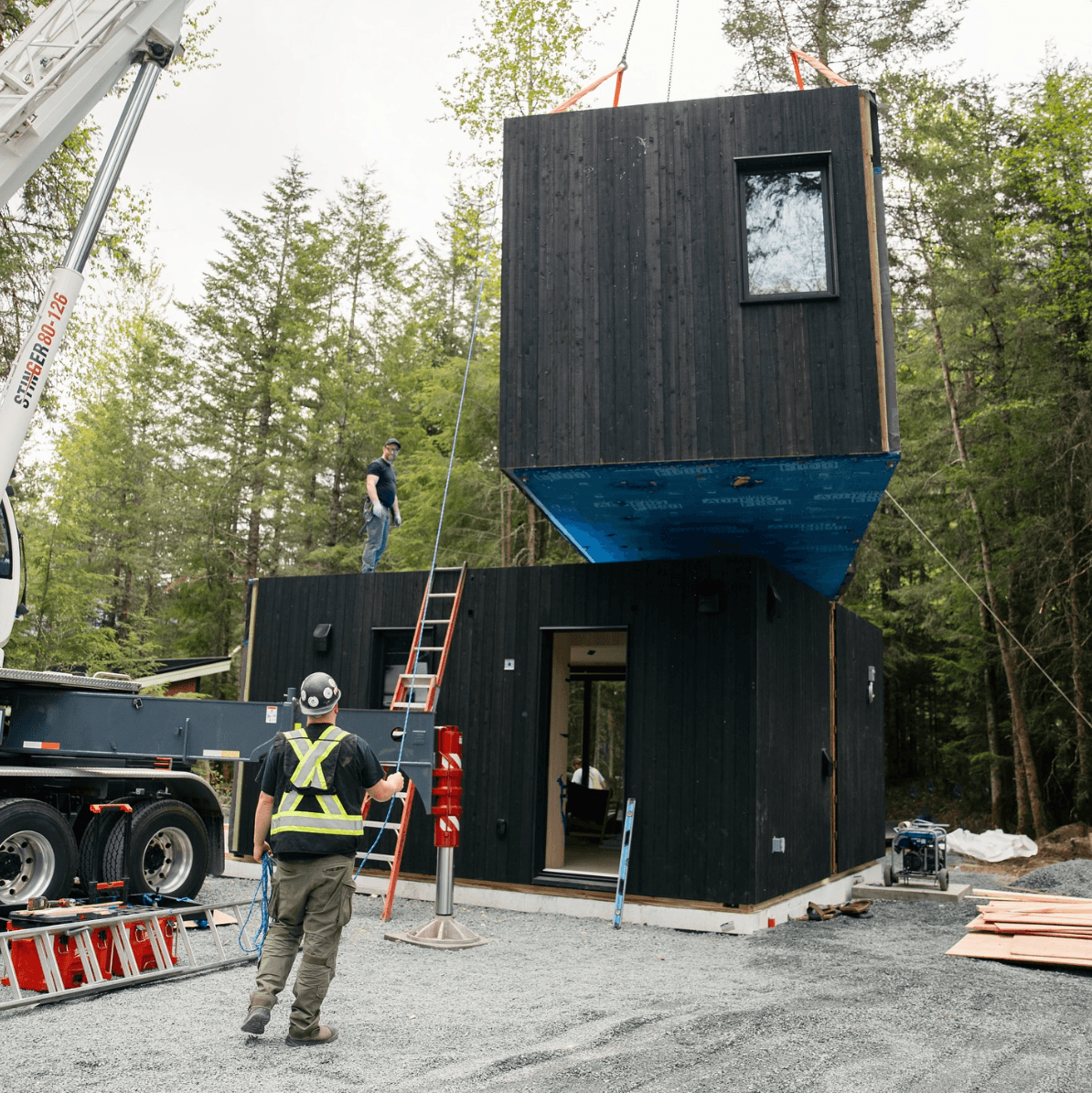
Modular or prefabricated options
A strong option when speed, quality control, and reduced on-site disruption matter.
Custom design
Best for more complex lots, design-sensitive properties, or homeowners who want something tailored from the ground up.
The key is choosing a path that fits the site instead of forcing the site to fit the idea.
Our process
We keep the process straightforward:
1) Lot review
We start by looking at zoning, access, setbacks, hazards, servicing, and overall fit.
2) Early planning
Before construction starts, we work through the major decisions that affect budget, approvals, and buildability.
3) Design and permitting
We help align the design with District requirements and coordinate the permit path.
4) Construction
Depending on the project, that may involve panelized, modular, pre-reviewed, or custom construction.
5) Final approvals and handover
We carry the project through to final inspection and completion.

Why homeowners work with NewlinesADU
Homeowners usually want the same thing: a clear answer on what is possible, what it is likely to cost, and how to avoid costly mistakes early.
A well-designed carriage house is only part of the job. In Squamish, it also has to work with local rules, site conditions, servicing, and the permit process.
Our role is to help you make smart decisions early, choose the right build method, and move forward with a plan that fits your lot and your goals.

I’m Gabriel, co-founder of NewlinesADU. I’ve been working in construction for more than 10 years and have spent much of that time on residential projects in the Sea to Sky.
In Squamish, carriage houses can make a lot of sense, but every property is different. Before getting too far into design, it helps to understand the site constraints, zoning, and likely build path.
That early review usually saves time and helps avoid the wrong approach.
Book a free lot assessment and we’ll help you understand what is likely possible on your site.